
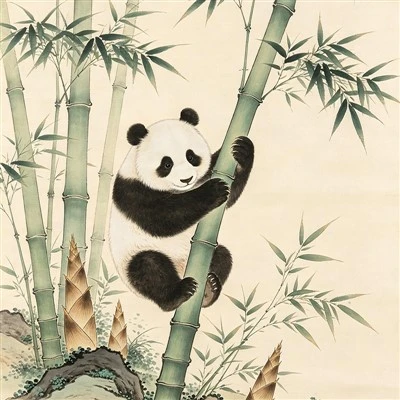
Well, folks, as a supplier of Gongbi Bamboo Painting, I've been knee - deep in the world of these beautiful artworks for quite a while. And let me tell you, the differences in Gongbi Bamboo Painting across different dynasties are just fascinating.
Tang Dynasty
The Tang Dynasty was a time of great prosperity and cultural flourishing in China. Gongbi Bamboo Painting during this era was still in its budding stage. Artists were more focused on capturing the general form and spirit of the bamboo. The lines were simple but bold, used to outline the basic shape of the bamboo leaves and stems.
Colors were relatively subdued. The bamboos were often painted in tones close to their natural color, with a hint of green and a touch of brown. This was mainly because the pigment technology was not as advanced as in later dynasties. The overall style was rather naive yet full of vitality, reflecting the open - minded and forward - looking attitude of the Tang people. In terms of composition, bamboos were usually drawn in a single frame, sometimes with a simple background like a rock or a cloud. It was like a snapshot of a moment in nature, capturing the essence of the bamboo in a straightforward way.

Song Dynasty
Oh boy, the Song Dynasty was a golden age for Gongbi Bamboo Painting. Artists during this period had a much deeper understanding of bamboo. They were not just satisfied with depicting the appearance but strived to convey the inner spirit of the bamboo.
The lines became extremely delicate and precise. Each bamboo leaf was painted with meticulous care, showing different shapes and postures. The veins on the leaves were clearly visible, and the brush strokes were so detailed that it almost seemed like you could touch the bamboo. When it came to colors, the Song Dynasty artists used a more refined palette. They mixed colors more skillfully to create a rich and natural look. Bamboo paintings often had a cool and elegant color scheme, which was in line with the aesthetic pursuit of the Song literati.
In composition, the paintings were more complex and well - structured. Bamboos were arranged in groups, interacting with each other, creating a sense of rhythm and harmony. Sometimes, birds or insects would be added to the paintings, adding a touch of life and movement. The Song Dynasty Gongbi Bamboo Paintings truly reached a high level of artistry, and many of them are still regarded as masterpieces today.
Yuan Dynasty
The Yuan Dynasty brought some new changes to Gongbi Bamboo Painting. Due to the influence of the Mongol rule, there was a certain degree of cultural integration. Artists in this period started to combine the freehand brushwork style with the Gongbi technique.
The lines in Yuan Dynasty bamboo paintings were looser compared to the Song Dynasty. While still maintaining the basic features of Gongbi, there was a bit more freedom in the brush strokes. This was a way for artists to express their personal emotions more freely. Colors also became more muted. The focus was more on the overall mood and atmosphere of the painting rather than the bright and vivid colors.
In terms of composition, the paintings often had a more solitary and desolate feeling. Bamboos were sometimes drawn alone or in a sparse group, away from the bustling world. It was a reflection of the artists' state of mind under the special historical background of the Yuan Dynasty.
Ming Dynasty
The Ming Dynasty witnessed a revival and further development of Gongbi Bamboo Painting. The lines in Ming Dynasty painting were thick and strong, with a sense of power. Artists used the lines to emphasize the three - dimensional effect of the bamboo. The bamboo stems looked solid and upright, while the leaves had a sense of flexibility.
Colors were more vivid and saturated. New pigment - making techniques allowed artists to use a wider range of colors. They often painted the bamboo in bright greens, and sometimes added some red or yellow accents to make the paintings more eye - catching.
Compositionally, Ming Dynasty paintings were more grand and magnificent. There were often grand scenes with large clusters of bamboos, and the paintings were more likely to have a decorative effect. It was suitable for large - scale interior decoration, which was in line with the opulent aesthetic preferences of the Ming Dynasty.
Qing Dynasty
In the Qing Dynasty, Gongbi Bamboo Painting had two main trends. On one hand, there were artists who adhered to the traditional Gongbi techniques, continuing to refine the details. The lines were extremely fine, and the color matching was very delicate. They tried to restore the elegance and refinement of the Song Dynasty paintings.
On the other hand, there were also some innovative artists who combined Western painting techniques with Gongbi Bamboo Painting. They introduced concepts such as light and shadow, making the bamboo look more realistic and three - dimensional. The colors became more diverse, and the paintings had a more modern feel.
Compositionally, Qing Dynasty paintings could be very diverse. Some were simple and elegant, while others were complex and full of details. It really depended on the artist's personal style.
Now, if you're into Gongbi art, we also offer a wide range of related paintings. You can check out our Wildlife Wall Pictures, Gongbi Crane Painting, Gongbi Fish Painting, Gongbi Flower Painting, and Landscape Wall Pictures for Living Room.
If you're interested in our Gongbi Bamboo Paintings or any of the other Gongbi artworks, feel free to reach out for a purchase discussion. Whether you're a collector, a decorator, or just someone who loves beautiful art, we're here to help you find the perfect piece for you.
References
- Xu, B. (2008). History of Chinese Painting. Beijing: Chinese Art Publishing House.
- Li, Y. (2012). Studies on Gongbi Painting Styles in Different Dynasties. Shanghai: Shanghai Culture Press.